

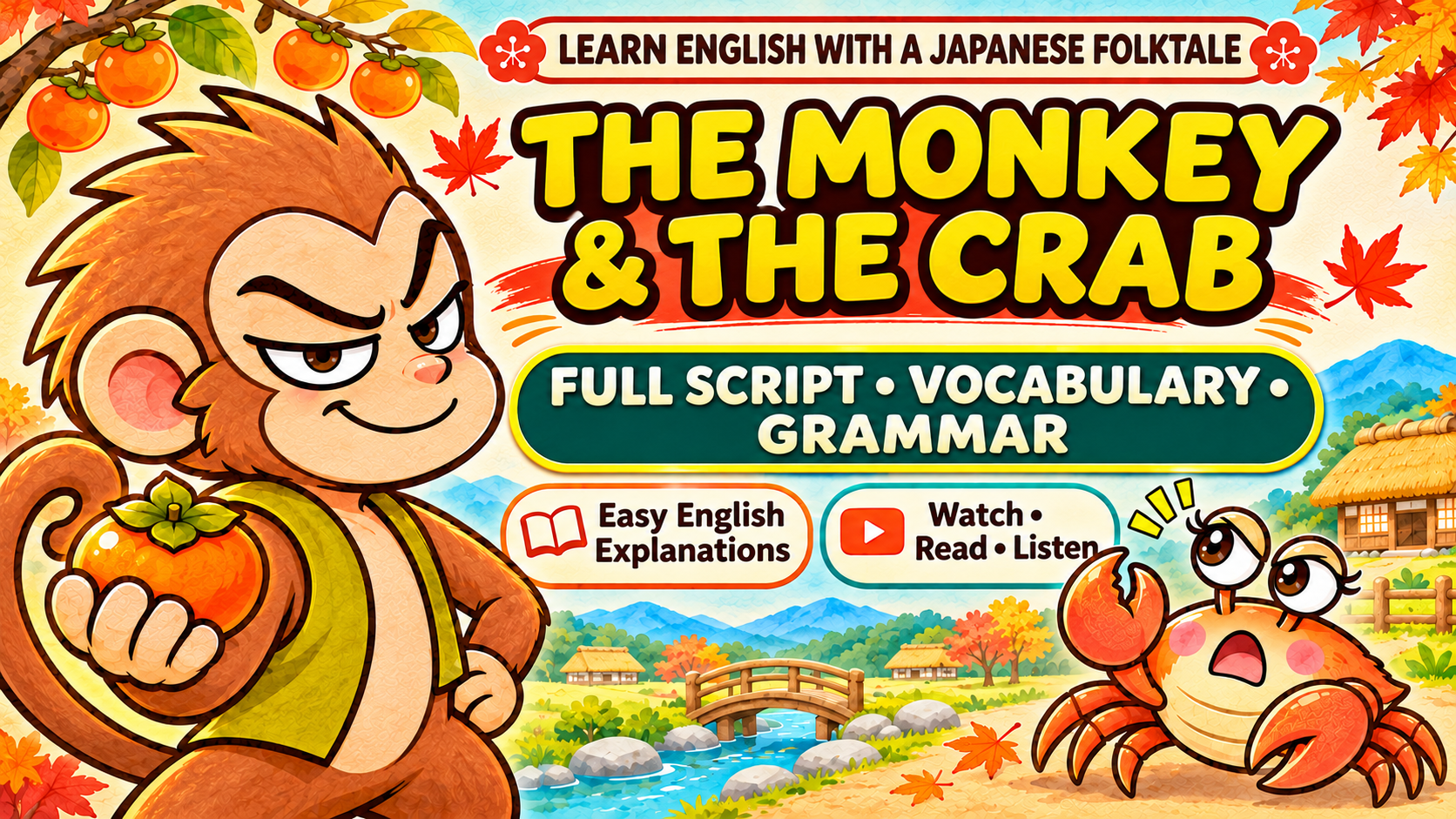
One rice ball. One tiny seed. One very greedy monkey. What could go wrong?
Explore The Monkey and the Crab, an animated Japanese folktale about sharing, trust and putting things right. Follow Crab and her small but determined friends as you learn English through their story.
This guide is for English learners from any language background. All explanations are in English, and you do not need to know Japanese. You will find the complete video script, simple word definitions and grammar notes for each scene. Children can explore it with an adult, and older learners can study at their own pace.
Watch The Monkey and the Crab in English
Watch the animated story on YouTube
The complete video is about six minutes long. The story starts straight away. At the end, LISA and MOGU review a useful phrase, and LISA explains how to keep learning with the series.
How to learn with the video and this guide
1. Watch for the story
Watch the animation first. Look at the characters’ faces and actions. You do not need to understand every word to follow what is happening.
2. Read one short scene
Choose a scene below. Read the script and check any unfamiliar words. Each time link opens the video near the beginning of that line, so you can hear it again.
3. Listen, pause and speak
Choose a useful line, such as Can you help me? Listen once, pause and say it aloud. Try to copy the rhythm as well as the individual sounds.
4. Listen again without the script
When you know the meaning, replay the scene without reading. Notice which words you can now recognise. You can also listen during your day. From time to time, stop and focus on one line rather than only listening in the background.
If you need captions, use the CC/subtitles control in the YouTube player. The available languages depend on the published caption tracks and your viewing environment. This article includes the full English script, so you can also follow the words here.
Meet the characters
| Name | Who or what is it? |
|---|---|
| Monkey | A monkey who trades a seed for a rice ball and later refuses to share. |
| Crab | A mother crab who grows the persimmon tree. |
| Little Crab 1 and Little Crab 2 | Crab’s two children. |
| Chestnut | A small nut who comes to help the family. |
| Bee | A flying friend who speaks up against unfair behaviour. |
| Mortar | A heavy pounding bowl with a strong voice. |
| Cowpat | A slippery lump of cow dung who joins the friends. |
| LISA and MOGU | Your story guides. LISA also narrates the action. |
Words such as Monkey, Crab and Bee begin with capital letters when used as character names in this script. Talking animals and objects are part of the story’s imaginary world.
Useful English phrases to try first
| Line from the video | Meaning and use |
|---|---|
| May I help? | Offer to help someone. |
| Can you help me? | Ask another person for help. |
| Leave it to me! | Tell someone you will take care of a task. |
| Are you all right? | Check whether someone is safe or feels OK. |
| Thank you for helping my family. | Thank someone for a particular action. |
| How can I make things right? | Ask what you can do to repair harm or correct a mistake. |
Notice the difference between offering and asking: in May I help?, you offer your help. In Can you help me?, you ask another person to help you.
Full English script with vocabulary and grammar notes
The script below includes all 95 spoken caption entries, from the opening exchange to the final learning guide and subscription message. It was checked against the video’s published English captions (en-GB), retrieved on 10 November 2026. Time links are approximate starting points.
The scene summaries, definitions and explanations are study notes, not extra dialogue. Any new practice examples are labelled separately.
1. A rice ball for a seed
Monkey offers Crab a persimmon seed in exchange for her rice ball.
00:00 — Monkey
Your rice ball for my seed?
00:02 — Crab
A seed?
00:04 — LISA — Narrator
One day, Crab found a rice ball. Monkey found a persimmon seed.
00:12 — Monkey
Plant it. You can grow a whole tree!
00:15 — Crab
A tree full of fruit? All right. Let’s swap.
00:21 — LISA — Narrator
Monkey ate the rice ball at once. Crab took the seed home.
Words and expressions
| Word or expression | Meaning in this story |
|---|---|
| rice ball | Rice pressed into a small shape so it can be held and eaten. |
| persimmon | A fruit that is often orange when ripe. |
| seed | A small part of a plant from which a new plant can grow. |
| whole | Complete; all of something. |
| swap | To give one thing and receive another. |
| at once | Immediately; without waiting. |
Grammar and listening notes
A short offer: Your rice ball for my seed?
Monkey is offering an exchange. Here, for means in exchange for. This short question is natural in conversation because the situation makes the meaning clear.
Plant it. / Let’s swap.
Plant it starts with the base form of the verb and gives an instruction. It means the seed. Let’s + base verb invites someone to do something together. Let’s swap means that Crab agrees to make the exchange.
Past forms in the narration
Found, ate and took are the past forms of find, eat and take. Crab took the seed home means she carried it to her home. We do not put to before home in this expression.
2. Planting the seed
Crab and her children plant the seed, water it and wait for a shoot.
00:28 — Little Crab 1
What’s that, Mum?
00:29 — Crab
A persimmon seed. Let’s plant it here.
00:33 — Little Crab 2
May I help?
00:35 — Crab
Yes. Bring a little water, please.
00:38 — LISA — Narrator
Every day, they watered the seed and waited. Then a tiny green shoot appeared.
00:44 — Little Crab 1
Look! It’s growing!
Words and expressions
| Word or expression | Meaning in this story |
|---|---|
| plant | To put a seed or plant in the soil so it can grow. |
| Mum | An informal British English word for mother. |
| bring | To carry something to a person or place. |
| water | A liquid; as a verb, to give water to a plant. |
| shoot | A new part of a plant growing above the soil. |
| appear | To become visible. |
Grammar and listening notes
May I help?
The little crab offers to help. May I + base verb asks whether the speaker can do something. Compare Can you help me? later in the story: that question asks another person to give help.
A little water
Water is uncountable in this sentence. A little water means a small amount of water. Use a little with an uncountable noun, not a few.
It’s growing!
It’s means It is. The present continuous uses am, is or are + an -ing form. Here, the little crab notices the plant growing. In watered the seed, water is a verb, and watered is its past form.
3. The tree grows fruit
The tree becomes taller. The orange fruit is ready to eat, but the green fruit is still hard.
00:48 — Crab
Grow, little tree. Grow tall and strong.
00:52 — LISA — Narrator
Days passed. The little tree grew taller. At last, orange persimmons hung from its branches.
00:59 — Little Crab 2
Can we eat them now?
01:00 — Crab
The orange ones are ripe. The green ones are still hard.
01:05 — Little Crab 1
They look delicious!
Words and expressions
| Word or expression | Meaning in this story |
|---|---|
| tall / taller | High in height / higher than before or than something else. |
| strong | Not weak; able to withstand force. |
| at last | Finally, after waiting. |
| branch | A part of a tree growing out from the trunk. |
| ripe | Ready to eat, especially when describing fruit. |
| delicious | Very good to eat. |
Grammar and listening notes
Grow tall and strong
Grow + adjective describes a change. Crab wants the tree to become tall and strong. Grew taller uses the past form grew and the comparative taller to show that its height increased.
The orange ones
Ones replaces a plural countable noun. The orange ones means the orange persimmons. The green ones means the green persimmons. This avoids repeating the same noun.
They look delicious!
Look + adjective describes how something appears. The fruit looks good to eat. They refers to the persimmons. Them in Can we eat them now? also refers to the fruit.
4. Asking Monkey for help
Crab cannot reach the fruit. Monkey says he is good at climbing.
01:09 — LISA — Narrator
Crab could not reach the fruit. Just then, Monkey came by.
01:14 — Crab
Monkey, can you help me?
01:16 — Monkey
Of course. I’m good at climbing!
01:19 — Crab
Please pick some ripe persimmons. We can share them.
01:24 — Monkey
Leave it to me!
Words and expressions
| Word or expression | Meaning in this story |
|---|---|
| reach | To get your hand or body close enough to touch something. |
| just then | At that exact moment. |
| come by | To pass a place or visit briefly. |
| climb | To move up something using your hands and feet. |
| pick | To take fruit or flowers from a plant. |
| share | To give part of something to others or use it together. |
Grammar and listening notes
Can you help me?
This is a request for help. You is the person who can help; me is the person asking for help. Can + base verb can express a request as well as ability.
I’m good at climbing!
Be good at + noun or -ing form describes a skill. After the preposition at, use climbing, not climb. Extra practice: I’m good at cooking. This cooking sentence is not a line from the video.
Leave it to me!
This useful phrase means I will take care of the task. It refers to the job Crab has asked Monkey to do. Learn the phrase as a whole rather than translating each word separately.
5. Monkey keeps the ripe fruit
Monkey eats the best fruit himself, even though he agreed to share.
01:27 — LISA — Narrator
Monkey climbed the tree. But he kept the ripe fruit for himself.
01:33 — Monkey
Mmm! Sweet and juicy!
01:37 — Crab
Please give us some too.
01:39 — Monkey
These are mine!
01:41 — Little Crab 1
But Mum grew the tree!
01:43 — Crab
We agreed to share.
Words and expressions
| Word or expression | Meaning in this story |
|---|---|
| keep / kept | To continue to have something / the past form of keep. |
| for himself | For his own use or benefit. |
| sweet | Having a taste like sugar. |
| juicy | Containing a lot of juice. |
| mine | Belonging to me. |
| agree to do something | To accept or say yes to doing something. |
Grammar and listening notes
Please give us some too.
Give + person + thing tells us who receives something and what they receive. Us means Crab and her children. Some means some of the persimmons, and too means also.
These are mine!
These refers to several things near the speaker. Mine means belonging to me and can stand alone. Compare my fruit, where my comes before a noun.
We agreed to share.
Agree to + base verb describes accepting a plan or action. Agreed is past: Crab reminds Monkey of their earlier agreement. Mum grew the tree uses grow with an object: she helped the tree grow.
6. Crab is hurt
Monkey throws a hard green persimmon. One little crab stays with Mum while the other looks for help.
01:47 — Monkey
You want a persimmon? Here!
01:50 — LISA — Narrator
He threw a hard green persimmon. It hit Crab and hurt her.
01:55 — Little Crab 2
Mum! Are you all right?
01:58 — Crab
My claw hurts. Please stay close.
02:01 — Little Crab 1
We’ll get help.
02:04 — LISA — Narrator
Monkey ran away. One little crab stayed with Mum. The other ran to find help.
Words and expressions
| Word or expression | Meaning in this story |
|---|---|
| throw / threw | To send something through the air with your hand / its past form. |
| hit | To strike or come into contact with something. |
| hurt | To cause pain; also to feel pain. |
| claw | A crab’s large gripping body part. |
| stay close | To remain nearby. |
| run away | To leave quickly to escape. |
Grammar and listening notes
Are you all right?
This question checks whether someone is safe or feels OK. The little crab is worried about Mum after the fruit hits her.
My claw hurts.
Hurt means feel pain here. My claw is singular, so the present simple verb is hurts. In It hit Crab and hurt her, hurt means caused her pain and is past. Hurt has the same base and past form.
One ... the other ...
There are two little crabs. One stays with Mum; the other means the remaining one. Ran to find help uses to + base verb to explain the purpose of running. We’ll means We will.
7. Chestnut and Bee come to help
The little crab tells Chestnut and Bee what happened. They help Crab get home.
02:12 — Little Crab 1
Chestnut! Bee! Please help us.
02:16 — Chestnut
What happened?
02:17 — Little Crab 1
Monkey hurt our mum.
02:19 — Bee
That’s not fair!
02:21 — Chestnut
We will come with you.
02:23 — LISA — Narrator
They helped Crab home and listened to what had happened.
02:27 — Crab
Thank you for helping my family.
Words and expressions
| Word or expression | Meaning in this story |
|---|---|
| chestnut | A nut with a brown outer covering. |
| bee | A flying insect that can sting. |
| happen | To take place. |
| fair | Treating people in a reasonable and equal way. |
| come with | To accompany someone. |
| family | People who are related to one another. |
Grammar and listening notes
What happened? / That’s not fair!
What happened? asks about an event in the past. That’s not fair! protests against unfair treatment. Fair here describes how someone is treated.
Thank you for helping my family.
Thank you for + noun or -ing form explains the reason for your thanks. Helping my family is the action Crab is grateful for.
What had happened
They listened to what had happened means they heard about the earlier events. What introduces the content they listened to, not a direct question. Had + past participle is the past perfect: the events happened before the friends listened to the story.
8. Different friends, different strengths
Mortar and Cowpat join the group. Each friend can help in a different way.
02:32 — Mortar
We can help too.
02:34 — LISA — Narrator
A heavy mortar and a slippery cowpat joined them. A cowpat is a lump of cow dung.
02:41 — Little Crab 2
You all look so different!
02:44 — Mortar
I’m heavy and strong.
02:46 — Cowpat
And I’m very slippery!
02:49 — Bee
Different friends can help in different ways.
02:52 — Little Crab 1
Then let’s work together.
Words and expressions
| Word or expression | Meaning in this story |
|---|---|
| mortar | A heavy bowl used with a pounding tool to crush or pound things. |
| cowpat | A lump of cow dung. |
| dung | Solid waste from an animal. |
| slippery | Easy to slide on; difficult to stand or hold firmly on. |
| different | Not the same. |
| work together | To cooperate on the same task. |
Grammar and listening notes
Explaining an unfamiliar word
A cowpat is a lump of cow dung explains the word cowpat with a short definition. This is a useful way to explain a thing that a listener may not know.
You all look so different!
You all includes every person being addressed. Look + adjective describes appearance. So strengthens different here: the friends look very different from one another.
In different ways
In different ways means using different methods. Different friends can help in different ways tells us that people do not need the same skills to help one another.
9. A place for each friend
The friends choose their places inside Monkey’s house. The little crabs wait outside.
02:56 — Little Crab 1
Monkey must listen to us.
02:58 — Chestnut
I will wait by the fire.
03:01 — Bee
I’ll hide by the water jar.
03:04 — Cowpat
I’ll stay by the door.
03:07 — Mortar
And I’ll wait up here.
03:09 — LISA — Narrator
Each friend had a place. The little crabs waited outside.
Words and expressions
| Word or expression | Meaning in this story |
|---|---|
| listen to | To give attention to a sound or to what someone says. |
| wait | To stay until something happens. |
| by the fire | Near the fire. |
| hide | To stay where you cannot easily be seen. |
| water jar | A large container for keeping water. |
| outside | Not inside a building or area. |
Grammar and listening notes
Monkey must listen to us.
Must + base verb expresses a strong need or obligation. The little crab wants Monkey to hear their message. Use listen to when you name the person or thing you are listening to.
I will ... / I’ll ...
Each friend says what they will do. I’ll is the short form of I will. After will, use a base verb: wait, hide or stay.
By the door / up here
By means near in these lines. Up here means here in a higher place. Watch where Mortar is waiting to connect the words with the picture.
10. Hot! Water! Ow!
Monkey sits by the fire, moves towards the water jar and is stung by Bee.
03:15 — LISA — Narrator
Monkey came home and sat by the fire.
03:19 — Monkey
Hot! Hot!
03:21 — Monkey
Water! Water!
03:22 — LISA — Narrator
Monkey leaned over the water jar. Buzz! Bee stung his sore cheek.
03:27 — Monkey
Ow! Ow! My face!
03:30 — Bee
You must not hurt others.
03:33 — Monkey
Be quiet!
Words and expressions
| Word or expression | Meaning in this story |
|---|---|
| sit / sat | To rest with your body supported by your bottom / its past form. |
| lean over | To bend your upper body forwards over something. |
| buzz | The humming sound made by a flying insect. |
| sting / stung | To hurt with a small pointed body part / its past form. |
| sore cheek | A painful part at the side of the face. |
| others | Other people. |
Grammar and listening notes
Short cries in conversation
Hot! and Water! are short expressions whose meaning is clear from the scene. Ow! expresses pain. My face! means that Monkey is complaining about pain in his face; he does not need a complete sentence to communicate it.
You must not hurt others.
Must not + base verb expresses prohibition: do not do this. It does not mean that the action is unnecessary. Bee tells Monkey that hurting others is not acceptable.
Be quiet!
This imperative begins with the base form be followed by an adjective. Monkey uses it angrily. A more polite request can be Please be quiet. That polite sentence is an extra example, not a line in this scene.
11. Monkey finally listens
Monkey slips, falls on his bottom and stops when Mortar lands in front of him.
03:34 — LISA — Narrator
Monkey ran to the door.
03:36 — Monkey
Whoa!
03:37 — LISA — Narrator
He slipped on Cowpat and fell on his bottom.
03:40 — Cowpat
Watch your step!
03:43 — LISA — Narrator
Mortar landed in front of him.
03:46 — Mortar
Stop. It’s time to listen.
03:49 — Monkey
All right! I’m listening!
Words and expressions
| Word or expression | Meaning in this story |
|---|---|
| slip | To slide unexpectedly and lose your balance. |
| fall / fell | To move down or lose your upright position / its past form. |
| bottom | The part of your body that you sit on. |
| land | To reach the ground after moving through the air. |
| in front of | Ahead of or before someone or something in position. |
| watch your step | Be careful where you put your feet. |
Grammar and listening notes
Fell on his bottom
Fall on your bottom describes landing on the part of your body you sit on. Fell is the past form of fall. His refers to Monkey.
It’s time to listen.
It’s time to + base verb says that now is the right moment for an action. Extra practice: It’s time to go. The go sentence is a new example, not part of the script.
I’m listening!
I’m means I am. Am + listening is present continuous: Monkey says he is paying attention now. All right! shows that he accepts what he is being told.
12. More than saying sorry
The little crabs explain why Monkey’s actions were wrong. Monkey asks how he can put things right.
03:52 — Little Crab 1
Mum worked hard to grow that tree.
03:56 — Little Crab 2
We trusted you.
03:58 — Monkey
I was greedy. I hurt her, and I ran away.
04:02 — Monkey
I’m sorry. How can I make things right?
04:07 — Little Crab 1
Bring back the fruit. Then help us care for the tree.
04:12 — Monkey
I will. And I won’t throw fruit at anyone again.
Words and expressions
| Word or expression | Meaning in this story |
|---|---|
| work hard | To put a lot of effort into something. |
| trust | To believe someone will act honestly or do the right thing. |
| greedy | Wanting more than you need, especially without thinking of others. |
| make things right | To correct a wrong or try to repair the harm done. |
| care for | To look after someone or something. |
| anyone | Any person; with a negative, no person is included. |
Grammar and listening notes
Worked hard to grow that tree
To grow that tree gives the purpose of Mum’s work. Hard means with a lot of effort. Be careful: hardly usually means almost not, so it does not have the same meaning as hard.
How can I make things right?
Monkey asks what action he can take to repair the situation. Make things right is a useful phrase about correcting harm, not about making physical objects.
I will. / I won’t ... again.
I will accepts the actions just requested. Won’t is will not. I won’t throw fruit at anyone again is a promise not to repeat the action. Throw something at someone describes throwing towards a target.
13. Returning the fruit and keeping a promise
Monkey apologises, returns the persimmons and helps care for the tree as Crab gets better.
04:18 — LISA — Narrator
Monkey brought back the ripe persimmons and apologised to Crab.
04:22 — Monkey
I’m sorry I hurt you. I’ll help you from now on.
04:28 — Crab
Thank you for returning the fruit. Be kind, and keep your promise.
04:33 — LISA — Narrator
As Crab got better, Monkey helped water the tree. The friends shared its fruit.
04:40 — Little Crab 2
There’s enough for everyone!
Words and expressions
| Word or expression | Meaning in this story |
|---|---|
| bring back / brought back | To return something / the past form of bring back. |
| apologise to | To tell someone you are sorry for doing something wrong. |
| from now on | Starting now and continuing into the future. |
| keep a promise | To do what you said you would do. |
| get better | To recover or improve. |
| enough | As much as is needed. |
Grammar and listening notes
I’m sorry I hurt you.
The words after I’m sorry explain what Monkey is sorry about. You can understand it as I’m sorry that I hurt you, with that left out.
Thank you for returning the fruit.
For is followed by the -ing form returning. Crab names the action she appreciates. Be kind, and keep your promise joins two instructions with and.
There’s enough for everyone!
There’s means There is. The fruit is understood from the scene: there is enough fruit for all the friends. As Crab got better describes her recovery happening over time while Monkey helps. As here is about time and change, not a reason meaning because.
14. Small friends make a big difference
Under the tree, the friends learn to share, listen and care for one another.
04:43 — Crab
Small friends can make a big difference.
04:46 — Bee
Especially when we work together.
04:49 — LISA — Narrator
And under the persimmon tree, they learned to share, to listen, and to care for one another.
Words and expressions
| Word or expression | Meaning in this story |
|---|---|
| make a difference | To have an effect or help change a situation. |
| especially | Particularly; more than usual in a certain situation. |
| learn to | To develop the knowledge or ability to do something. |
| share | To give part of something to others or enjoy it together. |
| one another | Each other. |
| care for one another | To look after and show concern for each other. |
Grammar and listening notes
Small friends can make a big difference.
A big difference means a strong effect. The line tells us that small friends can still do something important.
Especially when we work together.
Bee adds a thought to Crab’s sentence. The full idea is clear without repeating it: small friends can make a big difference, especially when they cooperate.
Learned to share, to listen, and to care
Learn to + base verb describes learning an action or way of behaving. Three actions follow learned here. One another refers to the friends caring about each other.
15. LISA and MOGU’s review and learning guide
LISA and MOGU remember the story, practise asking for help and say goodbye. LISA then explains how to use the series for learning.
05:00 — MOGU
They were all so different, but they helped each other!
05:04 — LISA
They did! Which friend did you like best?
05:09 — MOGU
Chestnut! Small, but brave!
05:12 — LISA
And what can you say when you need help?
05:16 — MOGU
Can you help me?
05:17 — LISA
Exactly! Let’s enjoy English through stories. See you on our next adventure!
05:23 — MOGU
Bye-bye!
05:25 — LISA
Enjoy English with Japanese Folktale Adventures. These stories are for children and adults, including beginners.
05:32 — LISA
Discover Japanese culture through stories of kindness, courage and friendship.
05:36 — LISA
First, enjoy the story. Turn on English subtitles if you need help. Then replay a short scene, pause, and say a favourite line aloud.
05:47 — LISA
Visit our blog at eigoclass.net for scripts, vocabulary and grammar notes, and explore more stories.
05:54 — LISA
Try listening again without subtitles. You can also listen during your day. Learn at your own pace, and enjoy English!
06:03 — LISA
Please subscribe to our channel for more Japanese stories in English. Thank you for watching!
Words and expressions
| Word or expression | Meaning in this story |
|---|---|
| brave | Ready to face something difficult or frightening. |
| through stories | By using or experiencing stories. |
| beginner | Someone who is starting to learn something. |
| subtitles | Written words on screen that show the speech. |
| aloud | With your voice, so the words can be heard. |
| at your own pace | At a speed that suits you. |
| subscribe to a channel | To follow a channel so you can find its new videos more easily. |
Grammar and listening notes
Which friend did you like best?
Which + noun asks you to choose from a group. Did marks this question as past, so the main verb is the base form like, not liked. Best means more than the others here.
They did!
LISA agrees that the friends helped each other. Did stands in for helped each other so she does not need to repeat the whole phrase.
Try listening again without subtitles.
Try + an -ing form suggests testing an activity. Without subtitles means with no subtitles. Listening here is not part of the present continuous, because there is no form of be before it.
Say a favourite line aloud
Choose one line you enjoy and speak it. Favourite means liked best, and aloud means using your voice. Subscribe to our channel uses subscribe followed by to.
Past forms to notice in the story
| Base form | Past form in the video | Meaning here |
|---|---|---|
| find | found | Discover something. |
| eat | ate | Take food into your mouth and swallow it. |
| take | took | Carry something away. |
| grow | grew | Become bigger, or help a plant develop. |
| hang | hung | Be supported from above. |
| keep | kept | Continue to have something. |
| throw | threw | Send something through the air. |
| hit | hit | Strike something. |
| hurt | hurt | Cause pain or injury. |
| run | ran | Move quickly on your feet. |
| sit | sat | Rest on your bottom. |
| sting | stung | Hurt with a pointed body part. |
| fall | fell | Lose your upright position or move down. |
| bring | brought | Carry something towards a person or place. |
| get | got | Become, as in got better. |
| have | had | Possess something. |
| be | was / were | Describe a state or situation. |
The narrator often uses the past simple to describe completed events. The characters also speak about what they need or feel now, so their dialogue is not always in the past. Compare He threw a hard green persimmon with My claw hurts.
Not every -ing form means the same thing
| Example from the video | How the -ing form works |
|---|---|
| It’s growing! | Is + growing: present continuous, describing something happening. |
| I’m good at climbing! | Climbing follows the preposition at and names an activity. |
| Thank you for helping my family. | Helping follows for and names the action being appreciated. |
| Try listening again without subtitles. | Try + listening suggests testing an activity. |
Look at the words around the -ing form. They help you understand its job in the sentence. Do not assume that every -ing form is a present continuous verb.
British English in the script
You will hear Mum and see the spellings apologised and favourite. Common American English equivalents are Mom, apologized and favorite. These differences do not change the basic meaning. The article uses British spelling to match the series.
Discover the story’s Japanese setting and its ideas
Rice balls, persimmons and a mortar
Crab’s rice ball is food made from rice pressed into a shape that is easy to hold. It is often called onigiri in Japanese. The persimmon tree gives the story its seed, growing plant and fruit. Notice that the orange fruit is ripe, while the green fruit is still hard.
A mortar is a bowl used with another tool for pounding or crushing. In this animation, Mortar is a living character: his weight and strength help the group. You can use pictures and short explanations like these to understand unfamiliar objects without translating every word.
Sharing, responsibility and making things right
We agreed to share reminds Monkey that the fruit was meant for everyone. Different friends can help in different ways shows how the friends bring different strengths to the same problem.
In this adaptation, Crab recovers from her injury. Monkey returns the fruit, apologises and helps care for the tree. The ending focuses on what he does after saying sorry. How can I make things right? is a useful question to discuss: what action could help repair the harm?
Enjoy the folktale as an introduction to Japanese storytelling and as a way to talk about fairness, kindness and keeping promises. The characters make these ideas visible through their choices and actions.
Talk about the story with a child or study partner
Start with one word if a full sentence feels difficult. The questions below include suggested answers; other answers may also be possible.
| Question | A possible short answer |
|---|---|
| Which friend did you like best? | Bee! |
| Who helped Crab? | Chestnut and Bee. |
| Was Monkey kind at first? | No, he wasn’t. |
| What can you say when you need help? | Can you help me? |
The first and fourth questions come from LISA’s review. The second and third questions, and all suggested answers, are extra practice. Chestnut and Bee is one possible answer to Who helped Crab?; you can name other friends too.
For a speaking activity, take turns saying Can you help me? and Leave it to me! Act out a simple task, such as carrying a book. Then change roles so both people practise asking and responding.
A short practice quiz
1. Choose the correct form: I’m good at (climb / climbing).
2. Choose the correct form: Thank you for (help / helping) my family.
3. Complete the phrase: It’s time (to listen / listening).
4. What does You must not hurt others mean? A: Do not hurt others. B: It is not necessary to hurt others.
5. What does They refer to in They look delicious!?
6. Who offers to help in May I help?: the speaker or the listener?
Answers and explanations
1. Climbing. Use an -ing form after the preposition at.
2. Helping. Thank you for is followed by a noun or an -ing form.
3. To listen. The pattern is It’s time to + base verb.
4. A. Must not expresses prohibition.
5. The persimmons growing on the tree.
6. The speaker offers help. In Can you help me?, the speaker asks the listener for help.
Listen again and find one line you can use
Return to a scene you enjoyed. Listen without reading, then check the script if you need it. Choose one line to say aloud today. A little focused practice is a useful way to make the story part of your English learning routine.
Watch The Monkey and the Crab again
Explore more stories in the series: learn English with Momotaro or learn English with Hanasaka Jiisan. Each story gives you another chance to listen, read and speak at your own pace.