



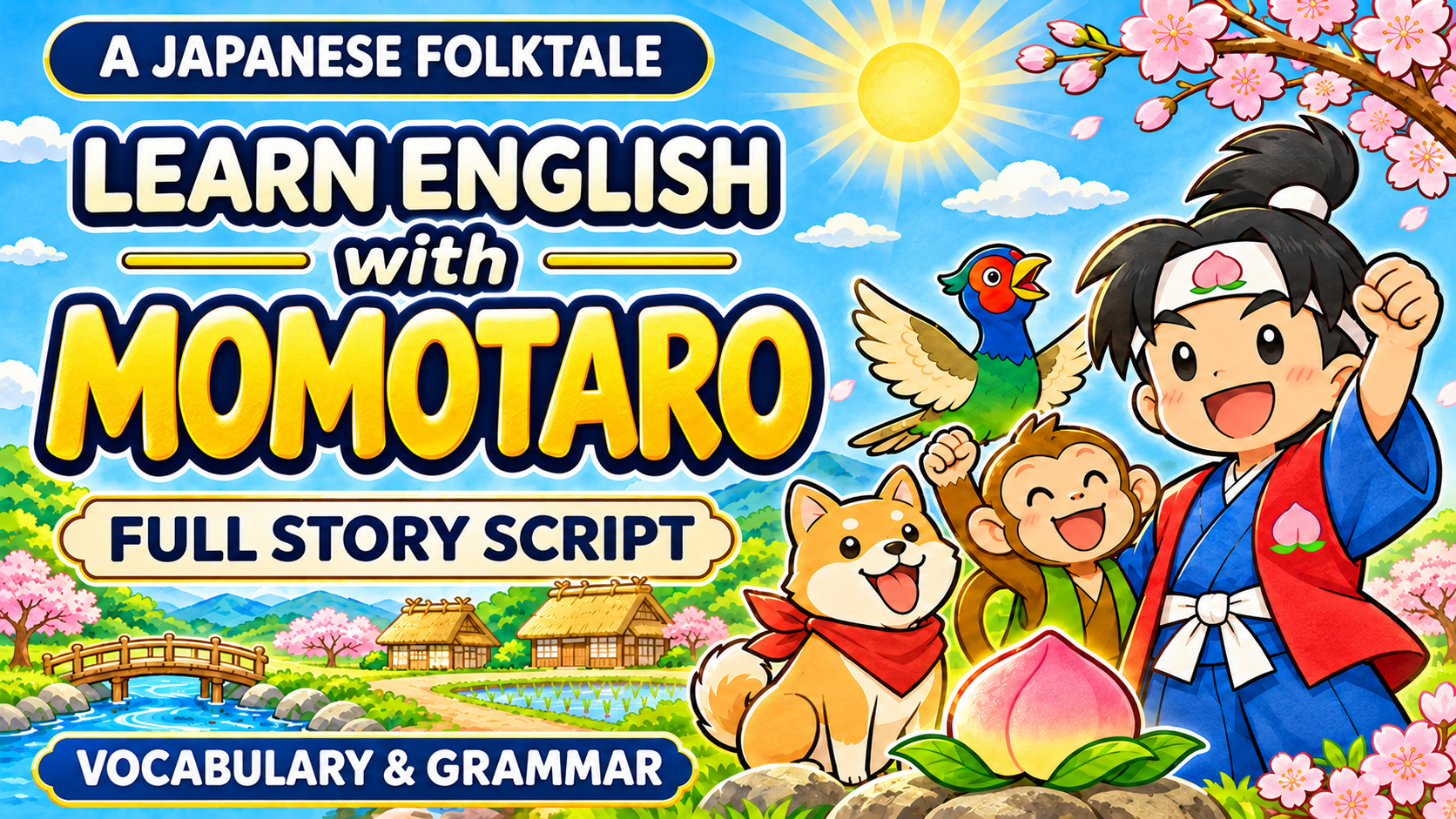
Can a boy born from a peach become a hero? Meet Momotaro, a kind boy who goes on an adventure with a dog, a monkey and a pheasant. Join LISA and MOGU as they open a magical storybook and visit old Japan.
This English-learning version of a Japanese folktale is for adults learning English and families learning together. You do not need to know Japanese. Read the explanations in simple English, check words you do not know, and listen again at your own pace.
Our adaptation follows a boy who feels afraid but wants to help others. As you enjoy the story, think about courage, friendship and kindness. You do not have to understand every word on your first watch.
Watch Momotaro in English
Watch Momotaro on YouTube. The video is about 7 minutes and 36 seconds long.
How to practise with the video
1. Watch for the story
Look at the pictures and actions. Who needs help? Who joins Momotaro? Try to understand the main events before studying every sentence.
2. Choose one short scene
Read that scene in the script below. Use the vocabulary and grammar notes to help. If an explanation is still difficult, use a dictionary in your own language.
3. Listen and read together
Play the scene again while reading the English. Notice how the words sound together. Pause and repeat one short line.
4. Listen without reading
When the meaning is clear, look away from the script and listen again. Can you recognise your chosen words? Return to the script whenever you need help.
Study a little at a time. Choose one to three useful phrases rather than trying to remember the whole script. Listening again is most useful when you also check meaning and practise using the language.
Using YouTube captions
If captions are available, select the CC button to turn them on. In the player settings, look for Subtitles/CC and choose English if it is listed. On some devices, Auto-translate may also be available. Choose your language if you need support, but remember that automatic translations can make mistakes. Options depend on the video and device. See YouTube’s official caption guide.
Five useful phrases from the story
| Phrase | Simple meaning | When to use it |
|---|---|---|
| Take care! | Be safe. | Say this when someone is leaving. |
| May I help you? | Can I do something to help? | Offer help politely. |
| I’m good at climbing! | I can climb well. | Talk about an ability. |
| We can do it together. | We can succeed as a team. | Encourage someone. |
| Be kind to others. | Treat other people well. | Remind someone to care about people. |
Say one phrase aloud. Then make it personal: “I’m good at drawing”, “I’m good at cooking”, or “I’m good at helping my friends”. These are practice examples, not extra lines from the video.
Meet the characters
| Character | Who they are |
|---|---|
| LISA and MOGU | Your guides before and after the folktale. |
| Momotaro | The Peach Boy: a kind boy who learns to be brave. |
| Grandfather and Grandmother | The older couple who raise Momotaro. They are called Grandfather and Grandmother in this adaptation. |
| The dog | A friend who can bark very loudly. |
| The monkey | A friend who is good at climbing. |
| The pheasant | A bird who can fly ahead and find the way. |
| The oni | A powerful creature who has taken the villagers’ food and treasure. |
Momotaro: the full English script
Read along or choose a scene. Each time link opens that part of the video on YouTube. Speaker names and scene headings help you follow the story; words in square brackets describe a sound. The magic words are a chant, not English vocabulary to memorise.
The magical library
00:00 LISA
Hello, everyone! Welcome to our magical library!
00:04 MOGU
Hello! Are you ready for an adventure?
00:07 LISA
Look! This magic storybook is full of tales from Japan.
00:11 MOGU
Can we go inside?
00:12 LISA
Yes! Come with us, and learn English along the way!
00:16 LISA
Copy our magic moves! Ready? One, two, three!
00:21 LISA and MOGU
CHICHIN PUI PUI
00:23 LISA and MOGU
HIRAKE
00:25 LISA and MOGU
GOMA
00:27 LISA
Oh!
00:28 MOGU
Wow!
A village in old Japan
00:40 LISA
Look, MOGU! We're in old Japan!
00:43 MOGU
It's beautiful! What's today's story?
00:47 LISA
Today's story is Momotaro, the Peach Boy. Let's begin!
To the hills and the river
00:54 LISA — Narrator
Long ago, in a quiet village, there lived an old man and an old woman.
01:01 Grandfather
I'm going to the hills to gather firewood.
01:05 Grandmother
And I'm going to the river to wash our clothes.
01:10 Grandfather
Take care!
01:12 Grandmother
You too!
01:14 LISA — Narrator
They worked hard every day, and they were always kind to each other.
A giant peach
01:20 LISA — Narrator
As the old woman washed the clothes, she saw something floating down the river.
01:25 Grandmother
Oh! What is that?
01:28 LISA — Narrator
It was a peach. A very, very big peach!
01:32 Grandmother
What a lovely peach! I'll take it home. We can share it.
A baby inside the peach
01:40 Grandfather
That's the biggest peach I've ever seen!
01:44 LISA — Narrator
Suddenly, the peach began to shake. Then it opened!
01:49 Sound
[Baby crying]
01:50 Grandmother
A baby! There's a baby inside!
01:54 Grandfather
He came from a peach. Let's call him Momotaro.
01:58 Grandmother
Welcome home, little one.
A kind but timid boy
02:02 LISA — Narrator
They loved Momotaro very much. He grew into a kind boy, but he was a little timid.
02:09 Momotaro
I'll try to help you, Grandfather.
02:12 Grandfather
Thank you, Momotaro.
02:14 Grandmother
You have a kind heart.
Sad news and a brave decision
02:20 LISA — Narrator
But one day, Momotaro heard some sad news. An oni from an island had taken the villagers' food and treasure.
02:29 Momotaro
That isn't right. The villagers need their food.
02:33 Momotaro
I'm scared of the oni. But I want to help.
Dumplings for the journey
02:40 Grandmother
Take these kibi dango. They're millet dumplings. Share them with your friends.
02:46 Momotaro
Thank you, Grandmother. I will.
02:49 Grandfather
Be brave, and be careful.
02:52 Momotaro
I'll do my best. I'll be back!
02:56 LISA — Narrator
And so, Momotaro set off.
The dog joins
03:04 Dog
Hello! Where are you going?
03:06 Momotaro
I'm going to the oni's island to help the villagers.
03:11 Dog
I can bark really loudly!
03:14 Dog
Woof! Woof!
03:15 Dog
May I help you?
03:17 Momotaro
Of course! Would you like a dumpling?
03:21 Dog
Yes, please! Thank you!
03:24 LISA — Narrator
Momotaro shared a dumpling, and the dog joined him.
The monkey joins
03:33 Monkey
Hello! Where are you going?
03:36 Momotaro
We're going to the oni's island. Will you help us?
03:40 Monkey
Yes! I'm good at climbing!
03:43 Momotaro
Then come with us. Here's a dumpling for you.
03:50 Monkey
Thank you! Let's go!
03:53 LISA — Narrator
The monkey joined them, and the three friends set off together.
Which way?
04:01 Momotaro
Oh dear. Which way should we go?
04:06 Dog
Is it this way?
04:08 Monkey
Or that way?
04:10 Momotaro
How can we find the way?
The pheasant joins
04:15 Pheasant
Hello, down there! Where are you going?
04:19 Momotaro
We're going to the oni's island. Will you help us?
04:24 Pheasant
Yes! I can fly ahead and find the way.
04:29 Momotaro
Wonderful! Have a dumpling.
04:33 LISA — Narrator
Now there were four friends, ready for an adventure.
Across the sea
04:38 LISA — Narrator
They reached the sea and found a small boat. Together, they sailed towards the island.
04:45 Dog
It's a long way!
04:48 Monkey
We can do it together.
04:51 Pheasant
Look! I can see the island!
04:54 Momotaro
Stay close, everyone.
Opening the gate
05:04 LISA — Narrator
At last, they reached a tall wooden gate. It was shut tight.
05:10 Pheasant
I can see a wooden bar inside!
05:14 Monkey
I can climb over and lift it.
05:17 Dog
I'll keep watch.
05:24 Momotaro
Ready? One, two, three!
05:31 LISA — Narrator
The gate opened. The friends went in together.
Working together against the oni
05:42 Oni
Who are you?
05:44 Momotaro
I'm Momotaro. Give back the villagers' food and treasure!
05:48 Oni
And what if I say no?
05:51 Momotaro
We won't let you hurt anyone. Friends, together!
05:55 LISA — Narrator
The dog barked very loudly.
06:00 Oni
That's too loud!
06:03 LISA — Narrator
The monkey jumped onto the oni's head.
06:05 Oni
Ow! Ow! That hurts!
06:08 LISA — Narrator
The pheasant pecked his foot. Down he fell!
06:13 LISA — Narrator
Momotaro jumped on top.
06:16 Oni
I give up! I'm sorry! I'll give everything back!
06:21 Oni
I won't take anything again.
Returning home
06:27 Momotaro
Keep your promise. Be kind to others.
06:31 LISA — Narrator
The friends took the food and treasure back to the village.
06:36 Momotaro
I'm home!
06:37 Grandmother
Welcome home, Momotaro!
06:39 Grandfather
We're so glad you're safe.
06:42 Momotaro
My friends helped me to be brave.
06:46 LISA — Narrator
And the village was peaceful once more.
Back in the library
06:54 MOGU
They shared their food and helped each other!
06:58 LISA
Yes! Which friend did you like best?
07:03 MOGU
I like Grandma best, because she makes lots of kibi dango!
07:09 LISA
It sounds like you understood the English!
07:12 LISA
Let's learn English and discover Japanese culture through stories from Japan.
07:17 MOGU
See you on our next adventure!
07:21 LISA and MOGU
Bye for now!
Keep learning and listen again
07:25 LISA
Enjoyed the story?
07:26 LISA
Explore words, grammar and Japanese culture on our blog.
07:30 LISA
Find the link in the description, then listen again!
Vocabulary: understand the story in simple English
These words and phrases come from the story, with a few clearly marked related words. Use the scene to help you remember the meaning.
Places, people and things
| Word or phrase | Meaning |
|---|---|
| folktale | An old story passed from person to person. |
| village / villager | A small community / a person who lives there. |
| hill / island | High land below a mountain / land with water all around it. |
| firewood | Wood used to make a fire. |
| peach | A round fruit with soft skin and a large stone inside. |
| dumpling | A small piece of dough, sometimes with food inside. See the culture notes for kibi dango. |
| treasure | Valuable things, such as gold or jewels. |
| wooden gate | A large entrance made of wood. |
| bar | Here, a long piece of wood that keeps the gate closed. |
Actions on the adventure
| Word or phrase | Meaning |
|---|---|
| gather | Collect things together. |
| float | Stay on the surface of water without sinking. |
| share | Let another person have or use some of what you have. |
| set off | Start a journey. Past form: set off. |
| join | Become part of a group or go with someone. |
| reach | Arrive at a place. Say “reach the sea”, without “to”. |
| sail | Travel across water in a boat or ship. |
| bark | Make the sound a dog makes. |
| climb | Move up something, using your hands and feet. |
| fly ahead | Fly in front of the others. |
| peck | Hit or pick at something with a bird’s beak. |
| keep watch | Look carefully for danger or changes. |
Feelings and relationships
| Word or phrase | Meaning |
|---|---|
| timid | Not very confident; easily afraid. |
| brave | Able to face danger or difficulty, even when afraid. |
| scared of | Afraid of something. |
| kind | Caring about others and helping them. |
| together | With other people; as a group. |
| each other | One person helps another, and the other helps them too. |
| give up | Stop trying; here, accept defeat. |
| give back | Return something to its owner. |
| promise | Say firmly that you will or will not do something. |
| safe | Not in danger. |
| peaceful | Calm and without fighting. |
| courage / friendship / kindness | Related theme words: facing fear / caring relationships between friends / being kind. |
Grammar through Momotaro’s dialogue
Start with the patterns you can use in your own life. The main examples below are from the video. The “Try it” sentences are extra practice.
1. Can + a base verb: abilities
I can bark really loudly!
Use can + a base verb to say what someone is able to do: can bark, can fly, can help. Do not add “to” or “-s” after can. “Really loudly” tells us how strong the sound is. In “Can we go inside?”, can also asks for permission.
Try it: Complete: “I can ___.” Use swim, cook, draw or another base verb.
2. Be good at + an -ing form
I’m good at climbing!
“Be good at” means “be able to do something well”. When an action follows at, use an -ing form: climbing, singing, drawing. “I’m” means “I am”.
Try it: Say two things you are good at: “I’m good at ___ and ___.”
3. Offering help and asking for help
May I help you?
The dog politely offers help. Compare this with “Will you help us?”: here, Momotaro asks someone else to help. “I” is the person speaking; “you” is the listener; “us” means the speaker and other people. In this context, will introduces a request.
Try it: Offer: “May I help you?” Ask: “Will you help me?”
4. Would you like…? An offer
Would you like a dumpling?
Use Would you like + a noun? to offer something politely. A friendly answer is “Yes, please” or “No, thank you”. “Do you like dumplings?” asks about a general preference, not whether someone wants one now.
Try it: Offer a drink: “Would you like some water?”
5. A destination and a purpose
I’m going to the oni’s island to help the villagers.
Break the line into three parts: I’m going / to the oni’s island / to help the villagers. The first “to” introduces a place. The second introduces a purpose: why he is going. Do not confuse “going to + a place” with the future pattern “be going to + a base verb”, as in “I’m going to help”.
Try it: Add a purpose: “I’m going to the shop to buy ___.”
6. Want to, try to and scared of
I’m scared of the oni. But I want to help.
Use want to + a base verb for something you wish to do. “Try to help” means make an effort to help. “Scared of” names what makes you afraid. Momotaro can feel afraid and still choose to help.
Try it: Make a sentence: “I want to ___.” Then try: “I’ll try to ___.”
7. Will and won’t: decisions and promises
I’ll do my best. I’ll be back!
“I’ll” means “I will”; “won’t” means “will not”. In these lines, will expresses intention or a promise. Use a base verb after will: “I will help”, “I will be back”. The oni promises, “I won’t take anything again.”
Try it: Make a helpful promise: “I’ll help you with ___.”
8. Let’s, be and stay: suggestions and instructions
Be brave, and be careful.
Let’s + a base verb includes the speaker and listener: “Let’s go!” means “You and I should go together”. “Be kind to others” asks someone to act kindly. “Stay close” asks the group not to move far away. These short forms can encourage or guide someone.
Try it: Invite a friend: “Let’s read.” Encourage them: “Be brave.”
9. Past simple: telling the story
The dog barked very loudly.
Many actions in a story happened in the past. Regular verbs often add -ed: bark → barked, jump → jumped, open → opened. Others change: go → went, see → saw, grow → grew, take → took. Some stay the same: set → set.
Try it: Change to the past: “The monkey jumps.” → “The monkey ___.”
10. Share with and help each other
They shared their food and helped each other!
Use share something with someone: “Share them with your friends”. “Each other” shows help moving both ways among people in a group. Their different abilities make the team stronger.
Try it: Complete: “I can share ___ with ___.”
11. Help someone (to) do something
My friends helped me to be brave.
After help, we can name the person and then use to + a base verb: helped me to be brave. We can also leave out to: “helped me be brave”. “Me” receives the help.
Try it: Make a sentence: “My friend helped me (to) ___.”
12. Because: giving a reason
I like Grandma best, because she makes lots of kibi dango!
“Because” introduces a reason. MOGU first says who he likes best, then explains why. “Lots of” means “a large number or amount of”. Grandma is an informal word for grandmother.
Try it: Complete: “I like ___ because ___.”
13. Useful short expressions
We’re so glad you’re safe.
“Glad” means happy about something. “Welcome home” greets someone returning home. “Oh dear” shows worry. “It sounds like you understood the English” means the speaker thinks this is true because of what they heard. Learn these as useful chunks.
Try it: Imagine a friend returns from a trip. Say: “Welcome home! I’m glad you’re safe.”
A closer look: five patterns for curious learners
“There lived an old man and an old woman.”
This story-opening pattern introduces people who lived in a place. In everyday English, we might say, “An old man and an old woman lived in a quiet village.”
“An oni … had taken the villagers’ food and treasure.”
“Had + past participle” is the past perfect. The taking happened before Momotaro heard the news. “Villagers’” has an apostrophe after s because the things belong to several villagers.
“That’s the biggest peach I’ve ever seen!”
“Biggest” compares this peach with all the others. “I’ve ever seen” means at any time in my life up to now. “I’ve” is “I have”.
“We won’t let you hurt anyone.”
After “let + a person”, use a base verb without to: let you hurt. The friends say they will stop the oni from harming people.
“Down he fell!”
This puts “down” first to make the fall more dramatic. The subject still comes before the verb: he fell. A neutral version is “He fell down”.
For more practice with future forms, visit British Council LearnEnglish. You do not need to master every grammar point before enjoying the story.
Discover Japanese culture through Momotaro
Why is he called the Peach Boy?
In Japanese, “momo” means peach. Momotaro’s name connects him with the fruit he comes from. In this story, an older couple finds a huge peach, and a baby comes out. This is a folktale, so magical events are part of its world. Our English-learning animation is an adaptation; other versions may tell parts differently.
What are kibi dango?
Grandmother gives Momotaro small dumplings for his journey. In the video, she calls them “millet dumplings”. Millet is a grain, like rice or wheat. Momotaro shares the food with the animals who become his companions.
You can also find sweets called kibi dango in Okayama, Japan. Modern versions can use rice and other ingredients, so they are not necessarily the same as the millet dumplings described in the tale. Read more in the Okayama Prefecture Official Tourism Guide.
What is an oni?
An oni is a creature from Japanese folklore. “Ogre” is one possible English description, but this guide keeps the Japanese word “oni”. In our animation, the oni has horns, carries a club and takes the villagers’ things. At the end, he apologises and promises to return them.
Courage, friendship and kindness
Momotaro does not begin as a fearless hero. He feels scared, but he cares about the villagers. His friends help him act bravely. Each friend contributes something different: a loud bark, climbing skills or the ability to fly.
Sharing food brings the companions together. Returning what was taken helps restore peace. These themes can help us talk about the story and our own lives. They are not values that belong only to Japan; readers from many cultures can connect with them.
Enjoy the story with children
For a young child, one word or action may be enough. Point to an animal, say “dog”, and make a “woof” sound together. Older children can choose a character, repeat a short line, or explain how the friends help. Keep the activity short and enjoyable.
Which character did you like best? Why?
What can the dog, the monkey and the pheasant do?
How does Momotaro feel before he leaves?
Can you be brave and scared at the same time?
How do you help your friends?
Is there a story about teamwork in your country?
Try a one-minute role-play. One person says, “May I help you?” The other replies, “Of course!” Then swap roles. If you are studying alone, say both parts yourself.
Quick practice: vocabulary and grammar
Complete each sentence before reading the answers.
1. I can ___ really loudly! (bark / barking)
2. I’m good at ___. (climb / climbing)
3. Would you ___ a dumpling? (like / likes)
4. Share them ___ your friends. (with / at)
5. The friends ___ in together. (go / went)
6. I like Grandma ___ she makes lots of dumplings. (because / but)
Answers and explanations
1. bark — use a base verb after can.
2. climbing — use an -ing form after at when you describe an action.
3. like — “Would you like…?” is a polite offer.
4. with — share something with someone.
5. went — this tells us what happened in the past.
6. because — the second part gives a reason.
Check your understanding of the story
1. Where does Grandmother find the peach?
2. Why does Momotaro go to the island?
3. How do the friends help him?
Suggested answers: 1. In the river. 2. To help the villagers and get their food and treasure back. 3. The dog barks, the monkey climbs and jumps onto the oni’s head, and the pheasant helps find the way and pecks the oni. Together, they help Momotaro be brave.
Frequently asked questions
Do I need to understand Japanese?
No. The dialogue, script and explanations here are in English. Japanese names and cultural words are explained in English too.
Is this only for children?
No. Adults learning English can also practise listening, useful expressions and grammar. Families can enjoy the story together.
Should I watch with or without captions?
Use the support you need. Start with captions or the script if that helps. Once the meaning is clear, try a short scene without reading and compare what you understand.
Who are the three friends and the four friends?
The three friends are Momotaro, the dog and the monkey. When the pheasant joins, there are four friends altogether. These numbers include Momotaro.
Do I need to learn the magic words?
No. “CHICHIN PUI PUI HIRAKE GOMA” is a playful magic chant in the opening. It is not an English grammar pattern or a phrase for everyday conversation.
Will listening in the background be enough?
You can replay the story for enjoyment, but also spend time checking meaning, listening carefully and saying phrases aloud. Use the story actively as well as casually.
Choose one line and listen again
You do not need to learn everything today. Choose one phrase you would like to use, find it in the video, and listen again. Say it aloud, then try it in a new situation.
We can do it together.
Let this be your next small step: one story, one useful phrase and one more listen. Join LISA and MOGU for another adventure through stories from Japan.