


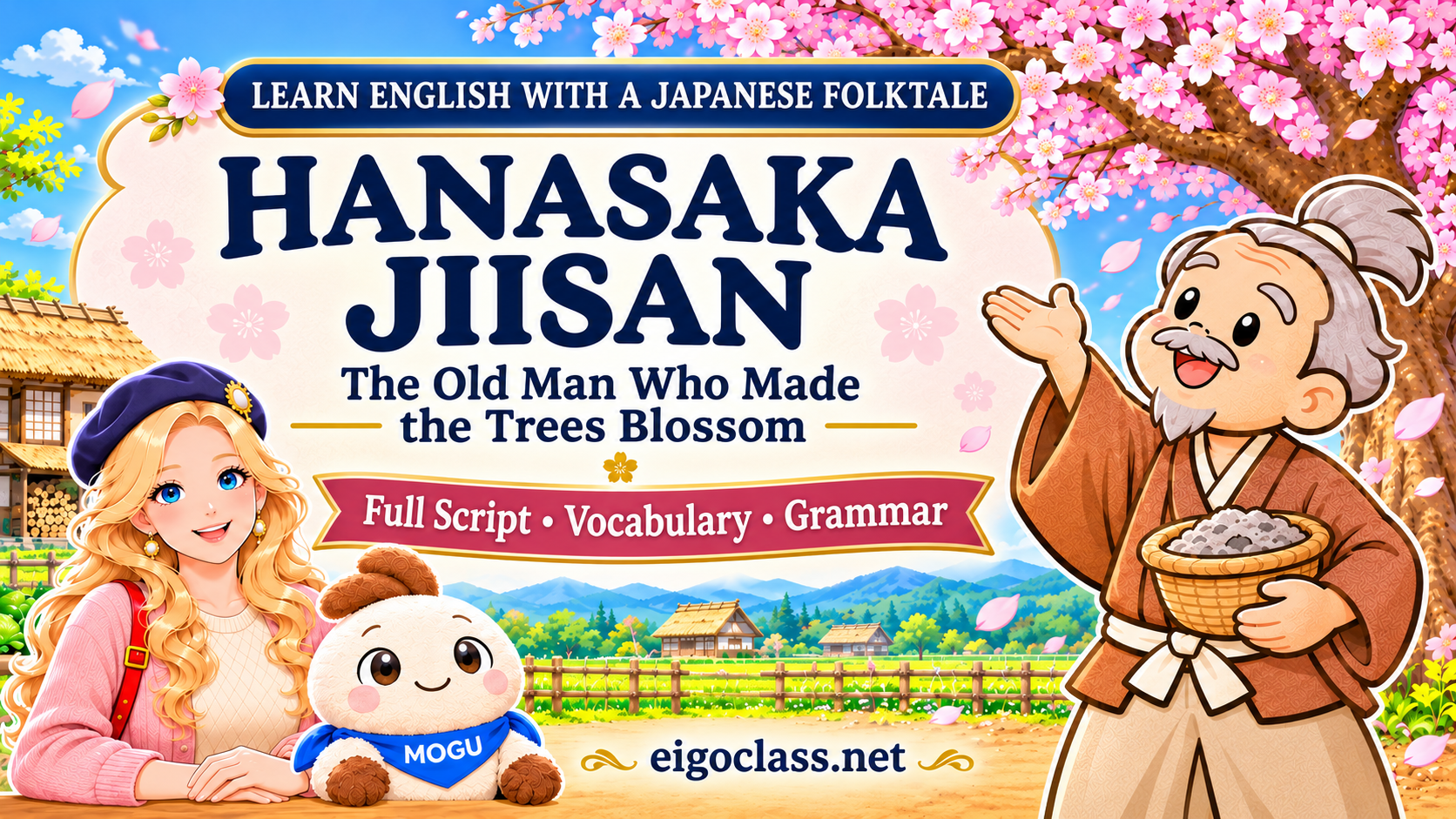
Can a handful of ashes make a tree blossom? Join LISA and MOGU for Hanasaka Jiisan: The Old Man Who Made the Trees Blossom, an animated Japanese folktale about kindness, sharing and the love between an elderly couple and their dog, Shiro.
This guide is for English learners from any language background. The explanations are in English, and you do not need to know Japanese. Read the complete script, explore useful words and grammar, and listen again at your own pace. Adults can study independently, and families can learn together.
The video uses British English and lasts about 6 minutes and 13 seconds. It is an English-learning adaptation of the folktale. Some lines are short and familiar; others introduce new patterns. Choose one scene at a time instead of trying to learn everything at once.
Watch Hanasaka Jiisan in English
Watch Hanasaka Jiisan on YouTube. On your first viewing, use the pictures and actions to help you follow the main events.
For parents: the story includes Shiro’s death. The act of hurting him is not shown, but the narrator mentions his death and the couple’s sadness. You may wish to watch with younger children.
A simple way to learn with this video
1. Enjoy the story first
Watch the characters and actions. Who shares? Who wants more? Try to follow the main story without stopping for every new word.
2. Study one short scene
Read that scene in the script below. Check its word meanings and grammar notes. If you need extra support, use a dictionary in your own language.
3. Listen and read together
Replay your chosen scene while reading the English. Each time link below opens the video near that line. Listen for words you now understand.
4. Pause and speak
Choose one short line, pause the video, and say it aloud. Copy the rhythm as well as the individual sounds. You can begin with “Thank you, Shiro” or “May I borrow your dog?”
5. Listen again without the script
When the meaning is clear, look away from the text and listen again. You can also replay the story during everyday activities. Return to the script when you want to check a word or sentence.
Using captions
When captions are available, use the video player’s caption button to turn them on or off. Look for English in the available caption languages. The controls vary by device; see YouTube’s official caption guide if you need help. You can read this article while listening even when captions are unavailable.
Meet the characters
| Character | Their role in this adaptation |
|---|---|
| LISA and MOGU | Your guides before and after the folktale. |
| The kind old man | A caring man who treats Shiro as family and shares with his village. |
| The old woman | His wife, who cares for Shiro and wants to help the neighbours. |
| Shiro | The couple’s white dog. He later appears in the old man’s dream. |
| The greedy neighbour | Another old man who wants gold and gifts for himself. |
| The lord | A local ruler who sees the beautiful blossoms. |
The speaker labels “Old Man” and “Old Woman” below refer to the kind couple. “Neighbour” is the other old man. This keeps the two men easy to tell apart.
Five useful phrases to learn first
| Phrase from the video | Simple meaning | Use it to… |
|---|---|---|
| May I borrow your dog? | Is it OK for me to use your dog for a time? | Ask politely to borrow something. |
| Please take good care of him. | Please look after him well. | Ask someone to be caring and responsible. |
| Let’s share it with the village. | Let us give some to the people in the village. | Suggest sharing something. |
| Let the old trees bloom! | May the old trees produce flowers! | Enjoy the magical moment in this story. |
| These flowers remind me of Shiro. | These flowers make me think about Shiro. | Talk about a memory. |
Make a phrase useful for your life: “May I borrow your pen?”, “Let’s share this cake”, or “This photo reminds me of home”. These are practice examples, not extra lines from the video.
The full English script with vocabulary and grammar notes
All 85 spoken or chanted entries are included, from the opening to the final learning message. Time links open the video near the start of each line. Speaker names and scene headings help you follow the story. The magic chant is shown in roman letters; it is not an English grammar exercise.
1. A magical library and a new story
LISA and MOGU introduce the adventure. LISA wears a colour that reminds us of cherry blossoms.
00:00 — LISA
Hello, everyone! Welcome to our magical library!
00:04 — MOGU
Hello! What's today's story?
00:06 — LISA
Today, a kind old man makes the trees blossom!
00:10 — LISA
That's why I'm wearing cherry-blossom pink today!
00:13 — MOGU
It really suits you!
00:14 — LISA
Thank you!
00:15 — LISA
Now, let's step into the world of the story.
00:19 — LISA
Are you ready for the magic words?
00:20 — MOGU
OK!
00:21 — LISA and MOGU
CHICHIN PUI PUI
00:23 — LISA and MOGU
HIRAKE
00:25 — LISA and MOGU
GOMA
Vocabulary in this scene
| Word or phrase | Simple English meaning |
|---|---|
| magical | Connected with magic. |
| kind | Caring about other people. |
| blossom | To produce flowers; also a flower on a tree. |
| suit someone | To look good on a person. |
| be ready for | To be prepared for something. |
Grammar and listening notes
Make something happen
“A kind old man makes the trees blossom.” The pattern is make + a person or thing + the base form of a verb. Here, the old man causes the trees to produce flowers. After “makes the trees”, use “blossom”.
Explain a reason with “That’s why”
“That’s why I’m wearing cherry-blossom pink today!” connects LISA’s clothes with the story. “That’s why…” introduces the result of a reason already mentioned.
Understand the magic chant
CHICHIN PUI PUI, HIRAKE and GOMA are romanised Japanese magic words. They are part of the story’s playful chant. You do not need to learn them as English vocabulary.
For more examples of the make and let patterns, see British Council: Verbs followed by the infinitive.
2. A little village in old Japan
The story begins in a quiet village.
00:39 — MOGU
Look, LISA! A little village!
00:42 — LISA
Our story is Hanasaka Jiisan: The Old Man Who Made the Trees Blossom.
00:46 — LISA
Let’s begin.
Vocabulary in this scene
| Word or phrase | Simple English meaning |
|---|---|
| village | A small place where people live. |
| story | A description of events, real or imagined. |
| made | The past form of make. |
| begin | To start. |
Grammar and listening notes
A title with “who”
“The Old Man Who Made the Trees Blossom” describes the old man. The words after “who” tell us which old man we mean. Here, “who” introduces a description rather than a question.
Invite someone with “Let’s”
“Let’s begin” means “You and I can start now.” Use Let’s + the base form: “Let’s read”, “Let’s listen” or “Let’s go”. These three short phrases are extra practice examples.
3. The old couple and Shiro
The old man and woman treat their white dog as part of their family.
00:50 — LISA — Narrator
Long ago, an old man and an old woman lived in a quiet village. They had a white dog called Shiro.
00:58 — Old Woman
Come here, Shiro. Here’s your dinner.
01:01 — Old Man
You’re part of our family.
01:04 — Shiro
Woof! Woof!
01:05 — LISA — Narrator
They were not rich, but they shared what they had.
Vocabulary in this scene
| Word or phrase | Simple English meaning |
|---|---|
| long ago | A long time in the past. |
| quiet | With little noise or activity. |
| part of | One member or piece of a larger group. |
| rich | Having a lot of money. |
| share | To use or give something together with others. |
Grammar and listening notes
A dog called Shiro
“They had a white dog called Shiro.” The words “called Shiro” tell us the dog’s name. “Had” is the past form of “have”.
What they had
“They shared what they had” means they shared the things they owned. Here, “what they had” is one group of words meaning “the things they had”. It is not a question.
Follow the pronouns
In this scene, “they” refers to the old man and woman. “You” in “You’re part of our family” refers to Shiro. Following these small words helps you follow the story.
4. Shiro finds a pot of gold
Shiro leads the old man to a tree. The old man digs and finds a surprise.
01:12 — LISA — Narrator
One day, Shiro led the old man to a tree. He began to dig.
01:18 — Shiro
Woof! Woof!
01:21 — Old Man
What is it, Shiro? Shall I dig here?
01:25 — LISA — Narrator
The old man dug carefully. Under the ground, he found a pot of gold!
01:30 — Old Woman
Oh! We can help our neighbours!
01:33 — Old Man
Thank you, Shiro.
Vocabulary in this scene
| Word or phrase | Simple English meaning |
|---|---|
| lead → led | To show someone where to go. |
| dig → dug | To make a hole in the ground. |
| carefully | With attention, to avoid a mistake or damage. |
| ground | The earth under your feet. |
| a pot of gold | A container holding gold. |
Grammar and listening notes
Offer an action with “Shall I…?”
“Shall I dig here?” asks whether the speaker should do something. The old man offers to dig where Shiro is showing him. A practice example is “Shall I open the door?”
Begin to do something
“He began to dig” means he started digging. In this part of the narration, “he” refers to Shiro. Later, “The old man dug carefully” describes the old man’s action.
Can + base verb
“We can help our neighbours!” expresses an ability or possibility. After “can”, use the base verb “help”. The old woman immediately thinks about helping other people.
5. The greedy neighbour borrows Shiro
The neighbour wants gold for himself and asks to borrow the dog.
01:37 — LISA — Narrator
A greedy neighbour saw the gold. He wanted some too.
01:41 — Neighbour
May I borrow your dog?
01:43 — Old Man
Yes. Please take good care of him.
01:47 — Neighbour
Come on! Find some gold for me!
01:50 — LISA — Narrator
But when the neighbour dug, he found only stones and broken pots.
01:55 — Neighbour
No gold? I wanted gold!
Vocabulary in this scene
| Word or phrase | Simple English meaning |
|---|---|
| greedy | Wanting more than you need, especially for yourself. |
| neighbour | Someone who lives near you. |
| borrow | To take and use something for a time, then return it. |
| take good care of | To look after someone or something well. |
| broken | Damaged; no longer whole or working. |
Grammar and listening notes
Ask politely with “May I borrow…?”
The person receiving something for a time says “borrow”. “May I borrow your dog?” asks for permission. Practise with “May I borrow your pen?” or “May I borrow your book?”
Borrow and lend
If you give your pen to someone for a time, you lend it. If you receive the pen for a time, you borrow it. The same action has a different verb depending on the person’s role.
Some and only
In “He wanted some too”, “some” refers to gold and “too” means “also”. Later, he finds “only stones and broken pots”: those things, without any gold.
6. Saying goodbye to Shiro
The couple lose Shiro and remember him with love.
02:00 — LISA — Narrator
The neighbour became angry and hurt Shiro. Sadly, Shiro died.
02:07 — LISA — Narrator
The old man and woman buried him with love.
02:11 — Old Woman
We miss you, Shiro.
02:14 — Old Man
We’ll always remember you.
Vocabulary in this scene
| Word or phrase | Simple English meaning |
|---|---|
| become → became | To change into a new state. |
| hurt | To cause pain or injury; the past form is also hurt. |
| die → died | To stop living. |
| bury → buried | To put a dead person or animal into the ground. |
| miss someone | To feel sad because someone is not with you. |
Grammar and listening notes
Say “We miss you”
“We miss you, Shiro” expresses sadness because Shiro is no longer with the couple. We can also use “miss” when a friend or family member is far away.
Make a promise with “will”
“We’ll always remember you” means “We will always remember you.” The couple promise to keep Shiro in their thoughts. “Always” shows that this feeling will continue.
7. Shiro appears in a dream
The old man sees Shiro in a dream and receives an unusual message.
02:19 — LISA — Narrator
A tree grew beside Shiro’s grave.
02:22 — LISA — Narrator
One night, Shiro appeared in the old man’s dream.
02:26 — Shiro — In the Dream
Use the wood to make a mortar.
02:30 — LISA — Narrator
A mortar is a large bowl for pounding rice. The old man made one from the tree.
02:37 — Old Man
Is this another gift from you, Shiro?
Vocabulary in this scene
| Word or phrase | Simple English meaning |
|---|---|
| grave | A place where a dead person or animal is buried. |
| beside | Next to. |
| appear | To become visible or arrive. |
| dream | Pictures and experiences in your mind while you sleep. |
| wood | The hard material that trees produce. |
| mortar | Here, a strong bowl used for pounding rice. |
| pound | To hit something repeatedly to crush or soften it. |
Grammar and listening notes
Use “to” to explain a purpose
“Use the wood to make a mortar” explains what the wood is for. The old man will use it in order to make the large bowl. A practice example is “Use a pen to write your name.”
For + an -ing form
“A large bowl for pounding rice” describes the bowl’s use. After “for”, the verb has an -ing ending: “pounding”.
Replace a noun with “one”
“The old man made one from the tree.” Here, “one” means “a mortar”. We use it to avoid repeating the noun.
8. Mochi and more gold
The couple pound rice. When gold appears, they want to share it.
02:42 — Old Woman
Let’s make some mochi!
02:44 — LISA — Narrator
They pounded the rice to make mochi, soft Japanese rice cakes. Then gold coins appeared!
02:51 — Old Man
Look! Gold again!
02:54 — Old Woman
Let’s share it with the village.
Vocabulary in this scene
| Word or phrase | Simple English meaning |
|---|---|
| mochi | A traditional Japanese rice cake. |
| gold coin | A small, flat piece of gold used as money. |
| again | One more time. |
| share something with someone | To give someone part of something or use it together. |
Grammar and listening notes
Share it with the village
“Let’s share it with the village.” Here, “it” refers to the gold. “The village” means the people living there. The pattern is share + something + with + a person or group.
Explain an unfamiliar food
The narrator calls mochi “soft Japanese rice cakes”. The name is followed by a short description. This helps listeners who have never seen mochi. You can use the same approach when describing food from your own country.
9. The mortar becomes ashes
The neighbour gets dirt instead of gold. He burns the mortar, and the kind old man asks for the ashes.
03:00 — Neighbour
May I borrow your mortar?
03:04 — Old Man
Yes. Please bring it back.
03:07 — LISA — Narrator
But the neighbour got only dirt.
03:09 — LISA — Narrator
In anger, he burned the mortar.
03:15 — Old Man
May I have the ashes?
03:18 — LISA — Narrator
He took the ashes home in a basket.
Vocabulary in this scene
| Word or phrase | Simple English meaning |
|---|---|
| bring something back | To return something to a person or place. |
| dirt | Earth or soil. |
| in anger | Because someone feels angry. |
| burn → burned | To destroy or damage something with fire. |
| ashes | The grey material left after something burns. |
| basket | A container made from woven material. |
Grammar and listening notes
Ask to receive something
“May I have the ashes?” asks for permission to receive the ashes. The old man does not ask to borrow them and return them later.
Home without “to”
“He took the ashes home in a basket.” Here, “home” means “to his home”. The word already gives the direction, so the sentence does not need “to” before it.
A request to return an object
“Please bring it back” asks the borrower to return the mortar. “It” refers to the mortar mentioned in the previous line.
10. The bare tree blossoms
A breeze carries ashes onto a bare tree. Pink flowers open.
03:25 — LISA — Narrator
In the garden, a breeze lifted some ashes onto a bare tree. Suddenly, pink blossoms opened!
03:32 — Old Woman
Look at the blossoms! They’re beautiful!
03:36 — Old Man
Let the old trees bloom!
03:38 — LISA — Narrator
He scattered more ashes. Soon, the branches were full of flowers.
03:45 — Old Man
Thank you, Shiro.
Vocabulary in this scene
| Word or phrase | Simple English meaning |
|---|---|
| breeze | A gentle wind. |
| bare tree | A tree without leaves or flowers. |
| suddenly | Quickly and unexpectedly. |
| scatter | To throw small things over an area. |
| branch | A part of a tree that grows from the trunk. |
| be full of | To contain a lot of something. |
Grammar and listening notes
“Let” and “Let’s” have different patterns
“Let the old trees bloom!” follows let + a thing or person + the base form of a verb. In the story, it is a magical wish for the trees to flower. “Let’s share…” follows a different pattern: Let’s + base verb, inviting the speaker and others to act together.
What does “old” mean here?
“Old trees” describes trees that have lived for a long time. “Old” alone does not mean “dead”. The story shows a bare tree becoming full of flowers. “Bare” describes the lack of leaves or flowers.
Blossom as a noun or verb
In “pink blossoms”, “blossoms” is a plural noun meaning flowers. In “makes the trees blossom”, “blossom” is a verb. The final -s can have different jobs in different sentences.
For more examples of the make and let patterns, see British Council: Verbs followed by the infinitive.
11. The lord sees the blossoms
The old man makes another tree bloom. The lord thanks him with a gift.
03:49 — LISA — Narrator
A lord was passing through the village. He stopped to look.
03:54 — Lord
Can you make this tree bloom too?
03:57 — Old Man
I’ll try, my lord.
03:59 — Old Man
Let the old trees bloom!
04:03 — LISA — Narrator
Pink petals danced in the air. Everyone smiled.
04:12 — Lord
Wonderful! You’ve brought joy to our village. Please accept this gift.
04:18 — Old Man
Thank you, my lord.
Vocabulary in this scene
| Word or phrase | Simple English meaning |
|---|---|
| lord | Here, a powerful local ruler in old Japan. |
| pass through | To travel through a place. |
| petal | One of the coloured parts of a flower. |
| joy | A strong feeling of happiness. |
| accept | To agree to receive something. |
Grammar and listening notes
Describe an action in progress
“A lord was passing through the village” uses was + an -ing form. This describes an action happening at a time in the past. Then “He stopped” tells us about the next event.
Stop to look
“He stopped to look” means he paused his journey in order to look. Compare “He stopped looking”: he was looking, then ended that action. The form after “stop” changes the meaning.
Connect an action with the present
“You’ve brought joy to our village.” “You’ve” means “you have”, and “brought” is the past participle of “bring”. The lord connects the old man’s action with the happiness people feel now.
Make something bloom
“Can you make this tree bloom too?” repeats make + a thing + a base verb. “Too” means the lord wants this tree to bloom as well as the other one.
12. The neighbour throws the ashes
No flowers appear, and the ashes blow into the lord’s face.
04:22 — Neighbour
I can do it too! Give me a gift!
04:26 — LISA — Narrator
He threw the ashes, but no flowers appeared.
04:30 — LISA — Narrator
The ashes blew into the lord’s face!
04:33 — Lord
Stop! Take him away!
04:36 — Neighbour
I was wrong. I’m sorry.
Vocabulary in this scene
| Word or phrase | Simple English meaning |
|---|---|
| throw → threw | To send something through the air with your hand. |
| blow → blew | To move or carry something with air or wind. |
| take someone away | To lead or move someone to another place. |
| wrong | Not correct; here, behaving badly. |
| sorry | Feeling regret about something you did. |
Grammar and listening notes
Understand “it” from the context
“I can do it too!” means the neighbour thinks he can also make a tree bloom. “Do it” refers back to an action already understood.
No + noun
“No flowers appeared” means that not a single flower appeared. “No” before a noun tells us that there are none.
Admit a mistake
“I was wrong. I’m sorry.” The first sentence describes the neighbour’s past behaviour. The second gives his apology now. Notice the change from “was” to “am”.
13. Remembering Shiro under the blossoms
The couple share their good fortune and think about Shiro.
04:44 — LISA — Narrator
The old man returned home. He and his wife shared their good fortune with the village.
04:51 — Old Woman
These flowers remind me of Shiro.
04:55 — Old Man
His love is still with us.
04:59 — LISA — Narrator
And under the blossoms, their village was full of kindness.
Vocabulary in this scene
| Word or phrase | Simple English meaning |
|---|---|
| return home | To go back to your home. |
| good fortune | Good luck or good things that happen to someone. |
| remind someone of | To make someone think about a person or thing. |
| still | Continuing now. |
| kindness | Caring and helpful behaviour. |
Grammar and listening notes
Remind someone of something
“These flowers remind me of Shiro.” The flowers make the old woman think about Shiro. Use remind + the person remembering + of + the person or thing remembered. A practice example is “This song reminds me of my friend.”
Follow “his” and “us”
“His love is still with us.” “His” refers to Shiro, and “us” refers to the old man and woman. The sentence expresses their feeling that Shiro’s love remains important in their lives.
14. Back in the library
LISA and MOGU remember their favourite moments and practise a useful line.
05:10 — MOGU
The blossoms were beautiful!
05:13 — LISA
They were! What did you like best?
05:18 — MOGU
The old man shared what he had. I want to share too!
05:23 — LISA
That’s lovely, MOGU. What English words did you hear?
05:28 — MOGU
May I borrow your dog?
05:30 — LISA
Well done! Let’s learn English and discover Japanese culture through stories.
05:35 — LISA
See you on our next adventure!
05:38 — MOGU
Bye-bye!
Vocabulary in this scene
| Word or phrase | Simple English meaning |
|---|---|
| like something best | To prefer it to the other choices. |
| lovely | Very nice or pleasing. |
| want to | To wish to do something. |
| Well done! | A phrase used to praise someone. |
| discover | To find out or learn about something. |
| adventure | An exciting or unusual experience. |
Grammar and listening notes
Ask a question about the past
“What did you like best?” uses did + the base form “like”. “What English words did you hear?” uses the same pattern with “hear”. Do not change these base verbs to past forms after “did”.
Want to + base verb
“I want to share too!” expresses MOGU’s wish to act like the kind old man. After “want to”, use the base form of the next verb.
15. How to keep learning
The final message explains how to use the video and this study guide.
05:42 — LISA
Enjoyed the story? Here’s how to learn with this series.
05:46 — LISA
First, listen and enjoy the story. You can turn on English captions for help.
05:52 — LISA
Next, use our blog to explore the script, vocabulary, grammar and Japanese culture.
05:59 — LISA
Visit eigoclass.net to read the study guide for this story.
06:04 — LISA
Then listen again, and try saying a few lines aloud. Enjoy learning at your own pace!
Vocabulary in this scene
| Word or phrase | Simple English meaning |
|---|---|
| caption | Words on screen showing what someone says. |
| script | The written words spoken in a video or play. |
| vocabulary | Words used in a language or topic. |
| grammar | The patterns used to put words together. |
| aloud | With your voice, so someone can hear. |
| at your own pace | At a speed that is comfortable for you. |
Grammar and listening notes
How to + base verb
“Here’s how to learn with this series” introduces a method. “How to learn” means “the way to learn”. You can also say “how to read” or “how to make something”.
Try an activity
“Try saying a few lines aloud” invites you to test an activity. The pattern try + an -ing form often means doing something to see what it is like or whether it helps. Start with one line that you understand.
Past forms you hear in the story
| Base form | Past form in the video | Simple meaning |
|---|---|---|
| have | had | Own something or keep an animal. |
| lead | led | Show someone where to go. |
| dig | dug | Make a hole in the earth. |
| find | found | Discover something. |
| see | saw | Notice something with your eyes. |
| grow | grew | Become bigger or develop. |
| make | made | Create something. |
| take | took | Move something to another place. |
| throw | threw | Send something through the air by hand. |
| blow | blew | Move air or carry something with air. |
| hurt | hurt | Cause pain or injury. |
| be | was / were | Describe a state or situation. |
The narrator often uses past forms because the story happened long ago. The characters also talk about what they feel or want at that moment. Listen to the difference between the narration and the conversations.
A British English spelling to notice
The script uses neighbour, the British English spelling. In American English, it is usually written neighbor. The meaning is the same. “Neighbours” is the plural form. Both spellings may appear in material you read.
Explore Japanese culture through the story
Mochi, a mortar and a pestle
Mochi is a traditional Japanese rice cake. In this story, the couple pound rice to make it soft and sticky. The large bowl is called a mortar, and the heavy tool used for pounding is a pestle. The video explains the mortar as “a large bowl for pounding rice”, so you can understand it from its use.
This is a useful way to explain something from your own culture. Give its name, then describe what it is or what people do with it. For example: “It is a bowl for…” or “We use it to…”. Complete these practice patterns with something familiar to you.
A lord in old Japan
The character is called a lord: a powerful local ruler in the world of the story. The old man addresses him as “my lord”, a respectful form of address. The adaptation uses this word to introduce the character to English-speaking viewers.
Cherry blossoms, sharing and remembering
The flowers show the change from a bare tree to a place full of life and colour. They also help the old couple remember Shiro. “These flowers remind me of Shiro” gives the scene a personal meaning: the flowers bring back their love for him.
Sharing is shown through actions as well as words. The couple share when they have little and again when they receive gold. Compare this with the neighbour’s wish for a gift. What does each person want, and how do their actions affect others? These questions help you discuss the story in English.
Speaking practice for adults and families
Start with a word or a short phrase if a full sentence feels difficult. Children can point to a character or act out an action before speaking. Adults can pause the video and practise the same line at a comfortable speed.
| Question | A possible answer |
|---|---|
| What did you like best? | The blossoms. |
| What did the old man find? | A pot of gold. |
| Why did the old woman like the flowers? | They reminded her of Shiro. |
| What would you like to share? | I would like to share my food. |
The last three questions and these answers are practice material, not extra dialogue from the video. Other answers are possible, especially when you talk about your own feelings.
Borrow and return: a short role-play
A: May I borrow your pen?
B: Yes. Please bring it back.
A: Thank you!
Use a real pen or another safe everyday object. Change roles, and then change the object. This role-play is a practice activity based on patterns from the story.
A short review quiz
1. May I (borrow / lend) your book? You want to receive the book for a time.
2. Let’s (share / shared) it.
3. Let the old trees (bloom / to bloom)!
4. These flowers remind me (of / with) Shiro.
5. Who does “his” refer to in “His love is still with us”?
Answers and explanations
1. Borrow. The person receiving something for a time borrows it.
2. Share. Use the base form after Let’s.
3. Bloom. Use the base form after let + a person or thing.
4. Of. The pattern is remind someone of someone or something.
5. Shiro. The couple feel that Shiro’s love is still important in their lives.
Listen once more and choose one phrase
You do not need to memorise the whole story. Choose one phrase you understand, replay its scene, and say it aloud. On your next viewing, notice whether you can recognise it without reading. Small, repeated practice can make the story more familiar.
Watch Hanasaka Jiisan again on YouTube
For another story in the series, explore Learn English with Momotaro: a Japanese folktale with script and grammar. Enjoy discovering English and Japanese stories at your own pace.